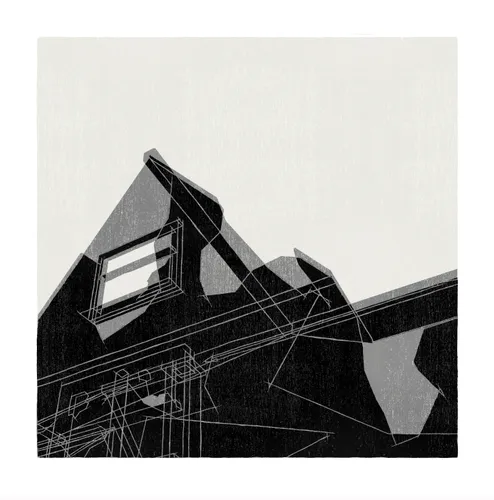
There is a bird in my pillow, 2023
"the pharmakon is neither remedy nor poison, neither good nor evil, neither the inside nor the outside, neither speech nor writing; the supplement is neither a plus nor a minus, neither an outside nor the complement of an inside, neither accident nor essence"
- Jacques Derrida, Positions
Opening by author Bjørn Sortland
Midtun Dowling is proud to present Pharmakon, an exhibition by Norwegian contemporary artist Njål Lunde.
Njål Lunde (b. 1973) is a multidisciplinary artist based in Haugesund, Norway. He studied at the National Academy of Fine Arts in Oslo and has developed an extensive artistic practice spanning drawing, photography, printmaking, sculpture, and animation.
Lunde has exhibited widely in Norway, with several solo exhibitions and participation in key group exhibitions, including multiple appearances at the National Annual Exhibition (Høstutstillingen). He has completed numerous public commissions, and his work is held in significant public and private collections.
Pharmakon
The exhibition takes its point of departure in Jacques Derrida’s concept of the pharmakon – a fundamental duality in which something can function simultaneously as remedy and poison. It describes a condition where stabilization and dissolution do not exclude each other, but rather depend on one another.
In Pharmakon, this concept becomes a framework for exploring how social and symbolic structures inherently contain the potential for both construction and collapse.
Through woodcuts and relief works in wood, Lunde examines how both material and symbolic systems carry within them the seeds of their own destabilization. The works articulate this duality through a deliberate interplay between digital and manual processes: the algorithmic repetition of CNC milling is confronted with the irreversible interventions of the hand. The result is not synthesis, but a sustained tension in which the material itself becomes a site of negotiation between control and rupture.
The motifs oscillate between geometric fragments, industrial structures, and organic formations. They do not appear as stable systems, but rather as residual structures—traces of spatial, political, and symbolic organization.
Operating between recognition and abstraction, the works remain open and context-dependent, allowing for multiple and even contradictory interpretations. They challenge the notion of fixed or definitive meaning.
In Pharmakon, nature and technology emerge as parallel, irreducible systems in continuous transformation. Through the imprint of the woodcut and the incision of the relief, images appear as traces of intervention, absence, and change.
Construction and deconstruction unfold as mutually dependent processes – as a pharmakon.
